
Direct answer: For most commercial spas, clinics, and medical aesthetics studios, a 4-motor electric facial bed is the best default choice. Four motors let you control height, backrest, leg/seat section, and trendelenburg (tilt) independently — which is what practitioners actually need for injectables, facials, lash, and body treatments. A 3-motor bed is the budget-conscious option for facials only, while a 5-motor bed adds a dedicated leg/extension axis or a second tilt axis for surgical-grade positioning. The single most important specification, however, is not the motor count — it is actuator thrust: for a bed rated to 200–250 kg, choose actuators rated at 6000 N for the backrest/height axes and 4000 N for lighter axes, combined with an 87° near-upright backrest, a quiet <50 dB drive, and ETL (UL 1647) or CE electrical certification.
Table of Contents
- What Counts as a Commercial Electric Facial Bed?
- 3-Motor vs. 4-Motor vs. 5-Motor: Specification Comparison
- Actuator Thrust: Why 6000 N vs. 4000 N Matters More Than Motor Count
- Clinical Ergonomics: The 87° Upright Backrest
- Electrical Compliance: ETL, CE, and UL 1647
- B2B Procurement: 7 Steps to Choose the Right Bed
- Factory Capability Behind the Specification
- Frequently Asked Questions
What Counts as a Commercial Electric Facial Bed?
A commercial electric facial bed (also sold as an electric treatment bed, aesthetic chair, or beauty bed) is a motorized platform built for continuous professional use — typically 6–12 treatments per day, 300+ days per year. That duty cycle is what separates it from a home-use table:
- Actuator duty rating — continuous/intermittent rated motors, not consumer-grade linear actuators.
- Frame construction — laser-cut, robotically welded steel chassis rather than bolted tube frames.
- Certification — ETL/UL 1647 or CE markings that let the bed pass a commercial inspection.
- Upholstery & foam — commercial-grade PVC or PU over high-density foam that resists compression over years of use.
- Warranty & spares — replaceable actuators and control boxes with documented part numbers.
3-Motor vs. 4-Motor vs. 5-Motor: Specification Comparison
The table below compares the three common configurations on the variables that matter in a B2B purchase.
| Specification | 3-Motor Bed | 4-Motor Bed | 5-Motor Bed |
|---|---|---|---|
| Controlled axes | Height + backrest + leg | Height + backrest + leg + trendelenburg/tilt | Height + backrest + leg + tilt + extra extension/leg-split |
| Typical bed thrust rating | 150–180 kg | 200–250 kg | 250–300 kg |
| Key actuators | Backrest 4000 N, height 6000 N | Backrest/lift 6000 N, leg/seat 4000 N | 6000 N heavy axes + 4000 N secondary axes |
| Backrest angle range | 0–70° | 0–87° | 0–87° plus tilt |
| Best treatment types | Facials, lash, brows | Injectables, facials, massage, waxing | Surgical aesthetics, body contouring, podiatry-style work |
| Controls | Hand control | Hand + foot control | Hand + foot + memory preset |
| Relative price (B2B) | Baseline | +15–25% | +35–55% |
| Best-fit buyer | New single-room studio | Most multi-room clinics | High-volume medical spas |
Actuator Thrust: Why 6000 N vs. 4000 N Matters More Than Motor Count
Actuator thrust (measured in Newtons) is the force a linear actuator can lift. It decides whether a bed lifts a real client smoothly at year three, or stalls and groans at month six.
- 6000 N actuators are specified for the high-load axes — height lift and backrest — because they carry the client’s body weight plus the moment arm of the moving section. A 6000 N actuator has a comfortable safety margin on a 200 kg-rated bed, lifts quietly, and runs cooler under repeated cycles.
- 4000 N actuators are appropriate for lighter, shorter-throw axes such as the leg/foot section or seat tilt, where the load and lever arm are smaller. Using 4000 N everywhere is the single most common cost-cutting shortcut on low-grade imports — and the usual cause of premature actuator failure.
- Duty cycle: request the actuator’s rated duty cycle (e.g. 10% or 25%) and its IP rating for the control box (IP54 or better for wet treatment rooms).
- Speed: a good commercial actuator moves at roughly 6–10 mm/s; faster is not better if it comes with a smaller motor and higher noise.
When you evaluate a 3-motor vs 4-motor facial bed quotation, ask for the actuator brand, thrust rating per axis, and duty cycle in writing before you compare price.
Clinical Ergonomics: The 87° Upright Backrest
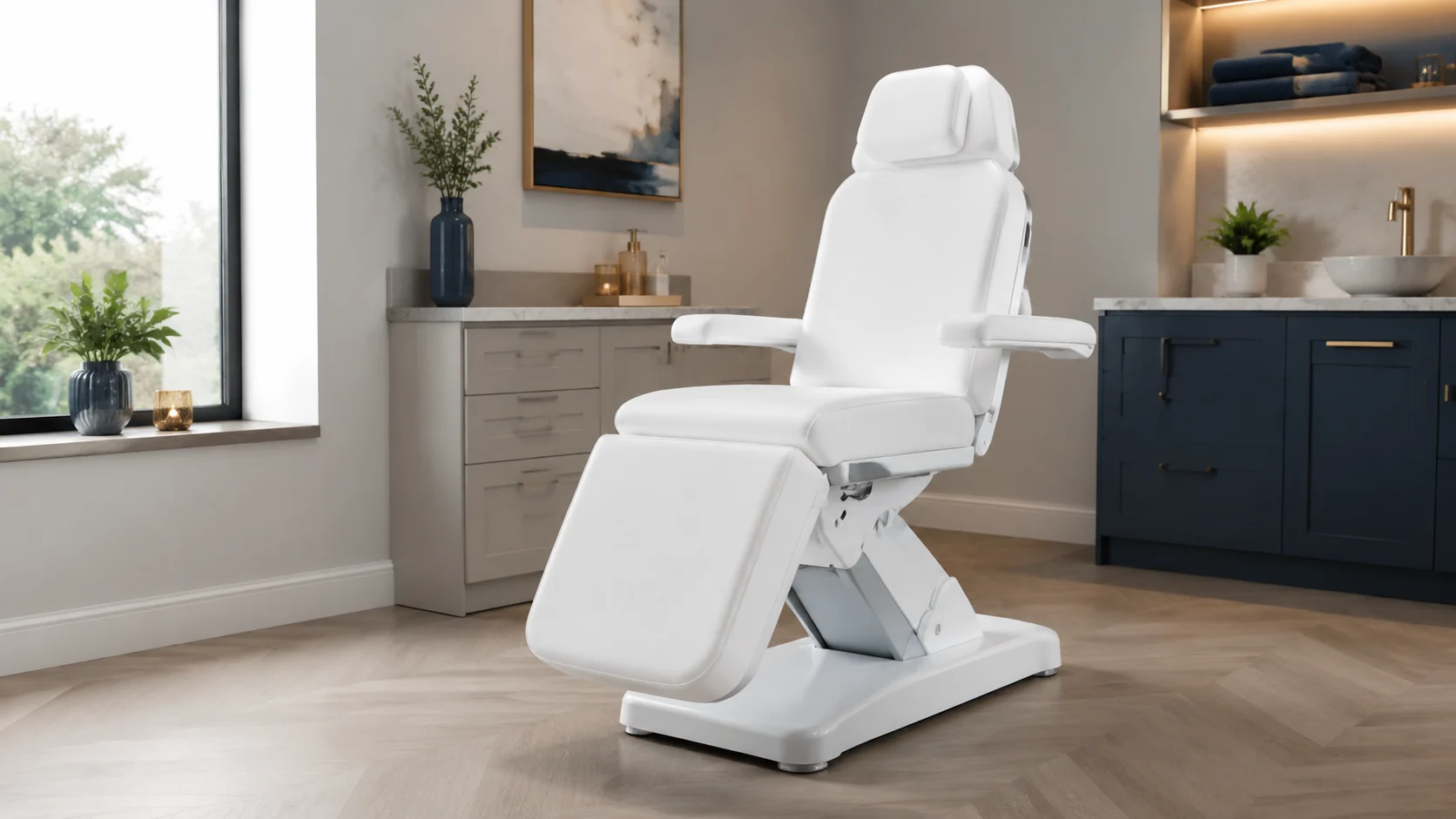
An 87° backrest places the client just short of fully vertical. In practice this is the sweet spot for two very different reasons:
- Client comfort & safety: near-upright positioning eases breathing, swallowing, and conversation during longer injectable or facial sessions, and helps clients with reflux, pregnancy, or mobility limitations.
- Clinician access: it opens the head and neck area for injectables while keeping the client’s body supported, reducing awkward forward-leaning postures that cause neck and shoulder strain.
- Height range: pair the 87° backrest with a lift range of roughly 520–900 mm so seated and standing practitioners can both work with a neutral spine.
Confirm both numbers — maximum backrest angle and the full height range — in the datasheet, not just in the marketing photos.
Electrical Compliance: ETL, CE, and UL 1647

For any motorized furniture sold into a commercial setting, electrical compliance is non-negotiable — and it is also a fast way to separate real factories from trading resellers.
- ETL / UL 1647: in North America, motorized massage and beauty furniture is typically evaluated to UL 1647 (Motor-Operated Massage and Exercise Machines) and listed through a Nationally Recognized Testing Laboratory such as Intertek (ETL). Ask for the certificate number and verify it — a logo image is not proof.
- CE: for the EU/UK, look for CE marking supported by an EMC (EN 55014) and low-voltage (EN 60335) test report, plus a Declaration of Conformity.
- Practical checks: correctly grounded plugs for the destination market, a fused/overload-protected control box, waterproof hand-control cable entry, and an emergency stop or lock-out for high-lift models.
- Documentation: request the electrical file with your quotation so it can be handed to a local inspector during installation.
B2B Procurement: 7 Steps to Choose the Right Bed

- Map your treatments. List every service the bed must support (facial, lash, injectables, waxing, massage). Treatments dictate motor count: facials may accept 3 motors; injectables usually require 4.
- Set the load and duty rating. Choose a bed rated at least 20% above your heaviest anticipated client load, and confirm the actuator duty cycle for your daily treatment volume.
- Confirm the ergonomic window. Verify backrest angle (87° target) and height range (520–900 mm target) against your practitioners’ working heights.
- Demand certification evidence. Collect ETL/UL 1647 or CE test reports and Declaration of Conformity before comparing prices.
- Evaluate the chassis build. Ask whether the frame is laser-cut and robotically welded, and request the upholstery/foam specification and the replaceable-parts list.
- Compare total cost of ownership. Add shipping, duties, installation, actuator replacement, and downtime — not just the unit price.
- Lock in warranty and spares. Get the warranty term, the actuator/control-box part numbers, and the spare-lead-time commitment in the purchase agreement.
Specifying a full treatment-room package? Coordinate this bed with the rest of your equipment: review pipeless vs. magnetic jet pedicure chairs for your pedicure stations, and the procurement guide to Japanese head spa water circulation equipment for your shampoo and head-spa rooms.
Factory Capability Behind the Specification

Specifications only hold up if the factory can actually build to them. When you audit a supplier, look for in-house laser cutting, robotic welding, and assembly lines rather than outsourced frames — these control weld quality and, in turn, how the bed carries load over years of use.
Frequently Asked Questions
Is a 4-motor facial bed worth it over a 3-motor bed?
For most commercial clinics, yes. The extra motor adds independent trendelenburg/tilt, which expands your treatment menu (injectables, drainage, body work) and improves client positioning. A 3-motor bed is a reasonable budget choice only if you are strictly performing facials and lash services.
What actuator thrust do I need for a 200 kg bed?
Specify 6000 N actuators on the high-load axes (height lift and backrest) and 4000 N on lighter axes such as the leg section. Using 4000 N across the board is a common cost-cutting shortcut that leads to early actuator failure.
Is ETL the same as UL 1647?
ETL is a certification mark issued by Intertek, a Nationally Recognized Testing Laboratory. Beds are typically listed to the UL 1647 standard and carry the ETL mark as evidence of that listing. Always verify the certificate number rather than relying on a logo.
Why does the backrest angle matter at 87°?
An 87° backrest sits just short of fully upright, which keeps the client’s airway open and comfortable for longer sessions while giving the clinician clear access to the head and neck. It also suits clients with reflux, pregnancy, or limited mobility.
Can I mix motor counts across a multi-room clinic?
Yes, and it is often smart: use 4-motor beds in injectables and multi-service rooms, and 3-motor beds in dedicated facial or lash rooms to control capital cost without limiting treatment capability.