
🎯 Direct Answer: Mobile vs. Fixed Manicure Tables (Salon Space Planning)
🎯 Quick Decision Rule: Mobile vs. Fixed Manicure Stations
Choosing between mobile and fixed manicure tables depends on salon layout permanence and multi-service flexibility: (1) Mobile Tables on Locking Casters (Best for Rental Suites, Beauty Academies & Pop-Up Studios): Allow instant reconfiguration and reclaiming of floor space for lash or facial treatments, featuring 4 heavy-duty 360° total-lock casters; (2) Fixed Commercial Stations (Recommended for High-Volume Dedicated Nail Salons): Provide maximum drawer storage capacity, integrated ducted ventilation channels, concealed under-desk power management, and permanent floor stability under continuous daily client volume.
| Mobile Table Advantage | 360° Total-lock casters; flexible floor clearance for multi-service studios |
| Fixed Station Advantage | Maximum storage drawers, concealed cable raceways & ducted ventilation |
| Working Stability | Fixed: Maximum mass (zero wobble) / Mobile: Dual-action locking caster brake |
| B2B Supply Terms | Kangmei factory-direct mobile and fixed stations, custom dimensions & finishes |
👉 Match your exact salon floor plan: Discover Kangmei’s Mobile & Fixed Commercial Manicure Tables with CE/cUPC/UL compliance and factory-direct wholesale pricing.
Quick Answer
A mobile manicure table is usually the better fit for a one-room studio, rental suite, training room, or multi-service salon that must reclaim floor space between appointments. A fixed manicure table is usually better for a high-use nail station where stability, integrated storage, concealed wiring, and a consistent dust-extraction setup matter more than rearrangement. Do not decide from the table footprint alone. Compare the full operating zone: table, two chairs, open drawers, technician movement, electrical cable, dust system, and cleaning access.
Why This Decision Matters More in a Small Salon
In a large salon, a poorly placed table is inconvenient. In a small salon, it can interrupt the whole workflow. A drawer may collide with the technician’s knee. A chair may block the entrance. A power cord may cross the client route. A portable extractor may occupy the only useful worktop area. A table that looks compact in a catalog can therefore consume much more floor space in operation.
The right question is not “Which table is smaller?” It is “Which table creates the lowest-friction service zone for the way this salon actually works?”
For a salon owner, the choice affects:
- appointments that can be completed without moving equipment;
- the time needed to reset and disinfect the room;
- access to supplies during a service;
- stability while filing or using an electric nail drill;
- cable and dust-extraction routing;
- the possibility of using the room for lashes, facials, consultations, or training;
- future changes to the floor plan.
Mobile vs Fixed Manicure Table: Side-by-Side Comparison
| Decision factor | Mobile manicure table | Fixed manicure table |
|---|---|---|
| Best use | Flexible rooms and low-to-moderate station utilization | Dedicated, frequently used manicure station |
| Stability | Depends heavily on frame stiffness, caster quality, brake design, and floor condition | Generally easier to make rigid because the base does not need to roll |
| Storage | Often reduced to control weight and width | More room for drawers, cabinets, waste bins, and integrated equipment |
| Power management | Requires a safe disconnect-and-store routine | Easier to route power through a wall, floor box, or fixed under-desk tray |
| Dust extraction | Portable or self-contained systems are easiest; fixed ducts restrict movement | Well suited to permanent local exhaust and concealed ducting |
| Cleaning access | Can be rolled away to clean beneath and behind | Requires toe-kick, wall gap, removable panels, or planned cleaning access |
| Reconfiguration | High, if the route and storage location are clear | Low; changing the layout may require electrical, carpentry, or ventilation work |
| Visual appearance | Can look temporary if cords and accessories remain exposed | Usually creates a cleaner built-in appearance |
| Installation | Typically simpler, but still needs safe power and equipment planning | Requires accurate site dimensions and earlier coordination |
| Expansion risk | Easy to relocate, but limited storage may become a constraint | Efficient for a stable operation, but costly to move later |
The practical rule
Choose mobile when flexibility is part of the business model. Choose fixed when permanence improves daily performance. If the table will remain in one location for more than 90 percent of appointments, buying casters “just in case” may add movement, maintenance, and height without creating meaningful value.
When a Mobile Manicure Table Works Best
A mobile table can be an excellent small salon manicure table when its movement has a defined purpose. Good examples include a solo suite that alternates between manicures and another treatment, a beauty academy that changes classroom layouts, an event service area, or a salon that needs to move the station for deep cleaning.
Mobility should not mean that the technician pushes a loaded desk through the salon several times a day. The safest and most practical mobile workflow is controlled: secure chemicals and tools, unplug equipment, coil the cable, release the brakes, move along a clear route, position the table, and re-engage every specified brake before service.
Check the caster system, not just the wheel count
Four wheels do not automatically make a table stable. A buyer should ask:
- Which casters have brakes: two, four, or another configuration?
- Does the brake stop wheel rotation only, or both rotation and swivel?
- How are the caster plates or stems attached to the cabinet or frame?
- Is the mounting area reinforced?
- Are replacement casters available with the same mounting pattern and height?
- Does the supplier test movement and wobble on a representative finished floor?
- Does the table remain level when the brakes are engaged?
The answers matter because looseness may originate above the wheel. Thin mounting panels, poorly tightened hardware, an unbraced cabinet, or an uneven floor can all create movement even when the caster itself is locked.
Control the moving mass
More drawers can make a mobile desk top-heavy. Bottles may tip, drawers may slide open, and a heavy internal dust collector can shift the center of gravity. Request drawer stops or retention features and confirm whether the manufacturer expects the table to be moved loaded or unloaded. A narrow table should not be treated like a general-purpose trolley unless the design is validated for that use.
Plan a parking position
A mobile table is useful only if it has somewhere to go. Mark the stored footprint on the floor plan and confirm that the parked table will not block a door, accessible route, fire equipment, cabinet, or other workstation. Also measure the narrowest point on the moving route, including door handles, chair bases, and wall-mounted displays.
When a Fixed Manicure Table Is the Better Investment
A fixed table is usually the stronger choice when manicures are a core service and the workstation remains occupied for much of the day. It can support deeper drawer banks, a wider worktop, a larger dust unit, and more deliberate routing of power and exhaust.
Fixed does not necessarily mean bolted to the floor. In this guide, it means a desk designed to remain in a designated position, with glides, a plinth, cabinet sides, or built-in joinery rather than everyday rolling casters.
Fixed storage can reduce service movement
In a small salon, vertical and technician-side storage can reduce trips across the room. However, storage must not consume the technician’s knee zone or force the client off-center. Ask the supplier for a drawing that shows internal cabinet dimensions, drawer travel, and clear legroom—not only the overall width.
Permanent cable routing is cleaner, but less forgiving
A fixed station allows electrical cables to enter through a grommet, under-desk tray, wall outlet, or floor box. This can keep cords out of circulation paths. OSHA’s general electrical safety guidance warns that cords should not create tripping hazards; although the exact rule that applies depends on the workplace and jurisdiction, the design principle is straightforward: do not make a loose extension lead part of the normal client route.
Before installing a built-in desk, locate outlets, lighting supplies, USB accessories, the nail lamp, electric file, and dust collector. Leave access for inspection and replacement. Concealed should not mean sealed inside an inaccessible cabinet.
Fixed stations suit permanent local exhaust
NIOSH guidance emphasizes placing local exhaust ventilation close to the nail work area. A fixed table makes it easier to preserve a repeatable relationship among the hand position, inlet, plenum, filter or duct, and exhaust path. If a table is mobile, a rigid exhaust duct may defeat the purpose; the buyer then needs a safe flexible connection or a genuinely self-contained system.
Do not compare dust systems by motor wattage alone. Request airflow and pressure data, inlet dimensions, filter specification, test setup, noise information, and instructions for filter replacement. Confirm whether air is filtered and recirculated or exhausted outdoors, and have the installation reviewed against local requirements.
Stability: How to Evaluate a Mobile Table Before Ordering
The most common buyer concern is that a mobile desk will wobble during filing. A useful evaluation separates five possible sources:
- **Caster play:** movement inside the wheel or swivel assembly.
- **Mounting play:** looseness where the caster meets the frame.
- **Cabinet flex:** side panels or joints racking under lateral force.
- **Worktop flex:** a long or thin top moving under arm pressure.
- **Floor variation:** grout joints, thresholds, soft carpet, or an uneven surface preventing all supports from sitting consistently.
Ask for a short unedited test video. It should show the complete table, the brake being applied, moderate pressure at several corners, drawer operation, and movement across a floor similar to the intended salon. A video that shows only a close-up of a locked wheel does not demonstrate whole-table stability.
Suggested pre-shipment checks
| Check | What the inspector should record | Why it matters |
|---|---|---|
| Brake function | Each specified brake applied and released | Finds non-engaging or inconsistent brakes |
| Lateral movement | Visible movement under a repeatable side load | Reveals caster, joint, or cabinet play |
| Drawer retention | Drawer behavior during controlled movement | Reduces accidental opening and product spills |
| Floor contact | All casters aligned on a flat surface | Identifies height or mounting inconsistency |
| Route test | Straight travel, turning, and threshold crossing | Shows steering effort and snag points |
| Hardware check | Fasteners, plates, inserts, and reinforcement | Helps prevent loosening after transport |
The supplier should define its own test method and acceptance criteria. Do not publish an unsupported “zero wobble” or load claim.
Storage, Legroom, and the Hidden Footprint
The catalog footprint is only the rectangle of the closed table. The operating footprint includes chair bases, knees, open drawers, a bin, technician access, and the client approach.
Use masking tape to mark the proposed table on the salon floor. Then add both chairs at the intended seat height. Simulate a client arriving, sitting, placing a bag, and leaving while the technician opens every drawer. Repeat the exercise with the door open and nearby equipment in use.
For accessibility planning in the United States, the 2010 ADA Standards include clear floor-space and work-surface provisions in defined contexts. They should be assessed as part of the facility design rather than converted into a generic claim that one table is “ADA compliant.” Consult the applicable local rules and a qualified designer for the actual project.
Better storage questions for a small salon
- Can daily-use tools fit in the top drawer without stacking?
- Can chemicals be stored upright and according to their safety instructions?
- Is there a separate location for clean and used items?
- Can the dust filter be removed without emptying the cabinet?
- Does the waste bin have a defined position?
- Will open drawers hit the technician’s chair or the wall?
- Can replacement consumables be stored elsewhere so the table stays compact?
Cable Management for a Table That Moves
Loose cables are one of the biggest weaknesses of a mobile station. The table needs a repeatable transition between “in service” and “ready to move.”
A practical design may include a cable hook or enclosed holder, a strain-relief point, a short equipment power path inside the table, and a clearly accessible main disconnect. The table should never be moved by pulling the cable, and the plug should not drag on the floor.
If an extension cord, floor cover, retractable reel, or floor outlet is proposed, have the installation reviewed for the local electrical code and workplace conditions. The furniture supplier can provide cable-routing features, but it should not make site-specific electrical approvals without the necessary information.
For a fixed desk, request access panels and enough separation between electrical components and collected nail dust. For either design, confirm the voltage, plug type, total connected load, grounding arrangement, and documentation for every powered component.
Dust Extraction: The Deciding Factor Many Buyers Miss
Mobility and ventilation can conflict. Effective source capture depends on the location of the inlet relative to the technician’s work. NIOSH identifies ventilated tables and local exhaust near the source as important controls for nail salon exposures. Moving a table changes the relationship between the inlet, room air currents, filter, duct, and outlet.
Choose among three broad configurations:
| Configuration | Mobility fit | Procurement notes |
|---|---|---|
| Self-contained built-in collector | Good if the system is compact and the cable is managed | Confirm actual capture performance, filter access, noise, and added table weight |
| Portable desktop collector | High table flexibility, but uses worktop space | Verify hand position, inlet coverage, cable route, and cleaning method |
| Ducted local exhaust | Best for a fixed station | Coordinate inlet, duct diameter, make-up air, exhaust location, and maintenance access |
Do not assume a recirculating dust collector controls every vapor or chemical hazard. Review product safety data sheets, local ventilation requirements, and the scope of the selected extraction system.
Folding and Nesting Tables: Useful, but Only for the Right Service Model
A folding table can reclaim the most floor area, but hinges and folding legs introduce additional joints. It may also provide little storage and limited support for a built-in collector. A nesting system can be more rigid, but the salon still needs a storage wall and a safe way to secure equipment.
For occasional manicure services, pop-ups, training, or home visits, folding may be reasonable. For continuous electric-file work, compare the sample for vibration, joint wear, finger-pinch points, setup time, and leveling. Ask whether the table may be folded with accessories attached; the safest assumption is no unless the manufacturer states otherwise.
Cleaning and Daily Reconfiguration
Mobility can improve cleaning because staff can reach the floor and wall behind the station. It can also spread dust if the table is moved before the work surface, drawers, inlet, and cable have been cleaned and secured.
A simple closing routine is:
- Remove and close product containers.
- Dispose of waste according to salon procedures.
- Clean the worktop and hand rest using compatible products.
- Service the dust collector or filter as instructed.
- Close and secure drawers.
- Switch off and unplug powered equipment.
- Coil and retain the cable above floor level.
- Release brakes, move slowly, park, and reapply brakes.
- Clean the newly exposed floor area.
For a fixed table, specify rounded internal corners where practical, removable drawers or trays, sealed edges, an accessible toe-kick, and service access for the collector. Avoid gaps that are too narrow to clean but wide enough to collect dust.
One-Person Studio Workflow Example
Imagine a 12-square-meter beauty suite used for manicures and lash services. A mobile table may allow the owner to move the nail station to a parking wall before converting the room. But that works only if the lash bed remains clear, the table fits through the gap, and the power cable has a safe storage point.
If the owner performs manicures six hours a day and only occasional lash services, a fixed manicure station may actually be more efficient. The second service could be scheduled in another time block or supported with a folding treatment surface. Constantly resetting the dominant station would waste time and increase wear.
Measure the workflow in minutes per day. Ten minutes spent clearing and reconnecting a mobile station across five working days is more than 40 hours per year. Flexibility has operational value, but it also has a labor cost.
Decision Table for Small Salons
Score each statement from 0 (not true) to 2 (very true).
| Statement | Points favoring mobile | Points favoring fixed |
|---|---|---|
| The room supports multiple service types | 0–2 | 0 |
| The station must move for deep cleaning or classes | 0–2 | 0 |
| A clear parking area and movement route exist | 0–2 | 0 |
| Manicures occupy most operating hours | 0 | 0–2 |
| Large integrated storage is essential | 0 | 0–2 |
| Permanent ducted exhaust is planned | 0 | 0–2 |
| Concealed permanent wiring is a priority | 0 | 0–2 |
| The floor has thresholds or uneven joints | 0 | 0–2 |
Use the result as a discussion tool, not an engineering formula. A strong ventilation or accessibility constraint may override the total score.
Sample Approval and Quality-Control Checklist
Before a bulk or project order, approve a physical sample or production-equivalent unit whenever possible. Check:
- overall and packed dimensions;
- worktop height, width, depth, edge shape, and finish;
- technician and client legroom;
- whole-table stability in working position;
- caster type, brake access, mounting reinforcement, and replacements;
- drawer size, extension, retention, and alignment;
- surface resistance against the salon’s intended cleaning products, using an agreed method;
- edge sealing at cutouts and high-contact areas;
- hand-rest position;
- dust inlet location, filter removal path, and service access;
- power rating labels, cable route, plug type, and documents;
- packaging protection around corners, worktop, casters, and accessories;
- assembly instructions and spare-hardware list.
Photograph the approved details and attach them to the purchase specification. For a multi-unit order, define which checks apply to every unit and which are sampled. Agree on how cosmetic defects, wobble, drawer alignment, and transit damage will be classified before shipment.
What to Send KANGMEI for an Accurate Quotation
Send more than a reference photo. A useful RFQ includes:
- required quantity and destination country;
- mobile, fixed, folding, or undecided configuration;
- maximum overall dimensions and measured room plan;
- preferred worktop and cabinet finish;
- drawer count and items that must fit;
- dust-extraction type and whether air is recirculated or ducted;
- voltage, frequency, plug type, and powered accessories;
- cable entry direction and nearest site outlet;
- target load or stability requirements and proposed validation method;
- logo or private-label requirements;
- packaging, spare parts, and replacement caster needs;
- target delivery date and Incoterm.
KANGMEI can use this information to discuss a compact manicure table configuration, storage layout, mobility hardware, and product customization. Final dimensions and performance claims should be confirmed on the approved specification and sample.
Planning a compact nail salon? Send KANGMEI your room dimensions, service mix, required storage, dust-extraction plan, voltage, quantity, and destination. Request a table layout and quotation based on the complete working zone—not the desk footprint alone.
Questions to Ask a Manicure Table Supplier
- Which caster functions are locked, and how are the casters mounted?
- What whole-table stability checks are performed with brakes engaged?
- Can you provide a drawing showing clear legroom and open-drawer space?
- Where are the dust collector, filter, cable, and service panels located?
- Can the filter be replaced without moving or dismantling the table?
- Which surfaces and edge-sealing methods are used around cutouts?
- What product-specific cleaning agents should be avoided?
- How are casters and corners protected during export shipping?
- Which parts are replaceable, and how long will compatible parts be available?
- Can the order be inspected against an approved sample and written checklist?
Common Buying Mistakes
Choosing only by external dimensions
A narrow table may have poor legroom or drawers that require extra side clearance. Measure the operating footprint.
Assuming every braked caster creates a rigid station
The frame, mounting point, floor, and brake type all affect movement. Request a whole-table demonstration.
Treating mobility as a substitute for layout planning
If there is no parking place or clear route, a rolling desk simply moves the obstruction.
Adding dust extraction after the table is finalized
The inlet, filter, duct, motor, cable, and service access change the cabinet and legroom. Specify the system early.
Hiding cables without planning maintenance
An inaccessible cable is not a managed cable. Ensure components can be inspected and replaced.
Buying maximum storage for a small room
Extra drawers add width and mass. Store bulk stock elsewhere and keep the table focused on daily service items.
KANGMEI Manicure Table Solutions for Small & Large Salons
Whether you require mobile stations with industrial lockable casters for flexible floor reconfiguration or heavy-duty fixed double manicure desks with integrated high-efficiency dust extraction, KANGMEI supplies direct-from-factory OEM salon furniture engineered for professional durability and ergonomic nail technician workflows.
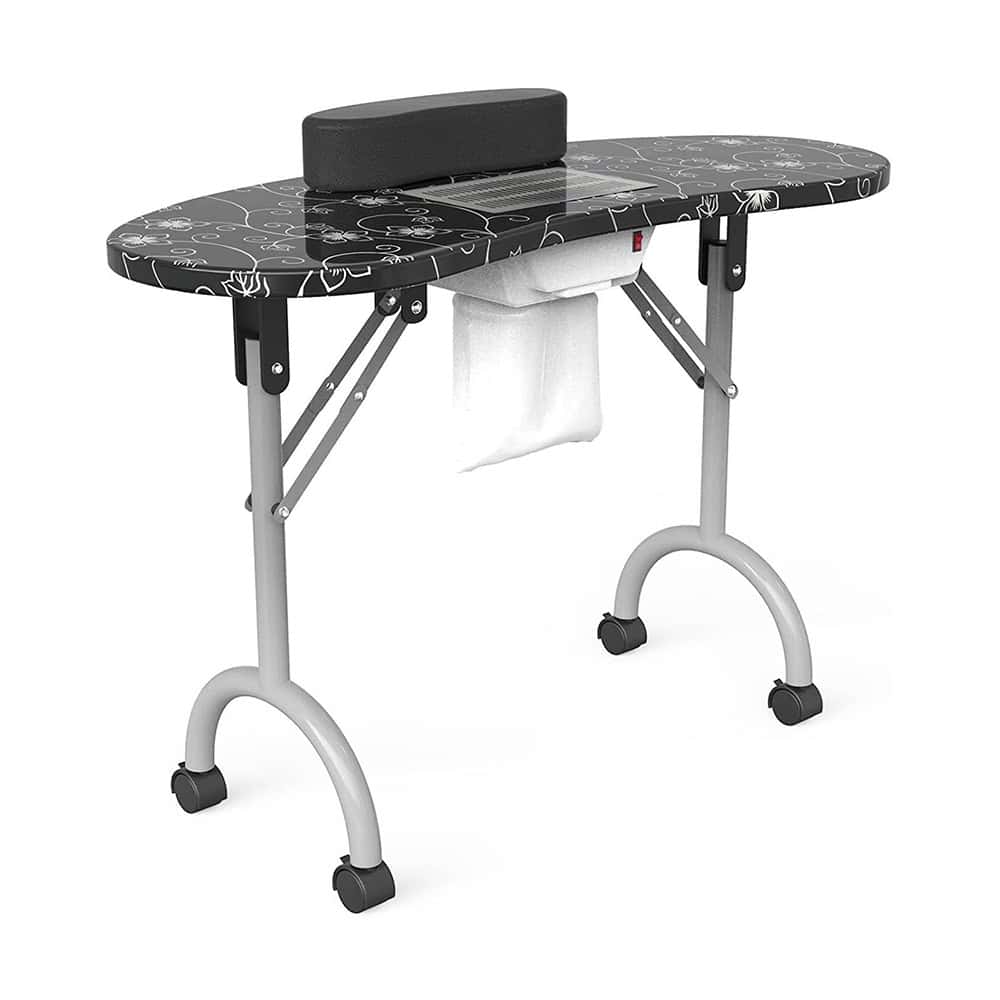
Model N078 — Portable Mobile Manicure Station
• Mobility: 4 Heavy-Duty Lockable Casters
• Filtration: Built-In Dust Collector
• Footprint: Compact Space-Saving Design
• Application: Boutique Salons & Mobile Techs
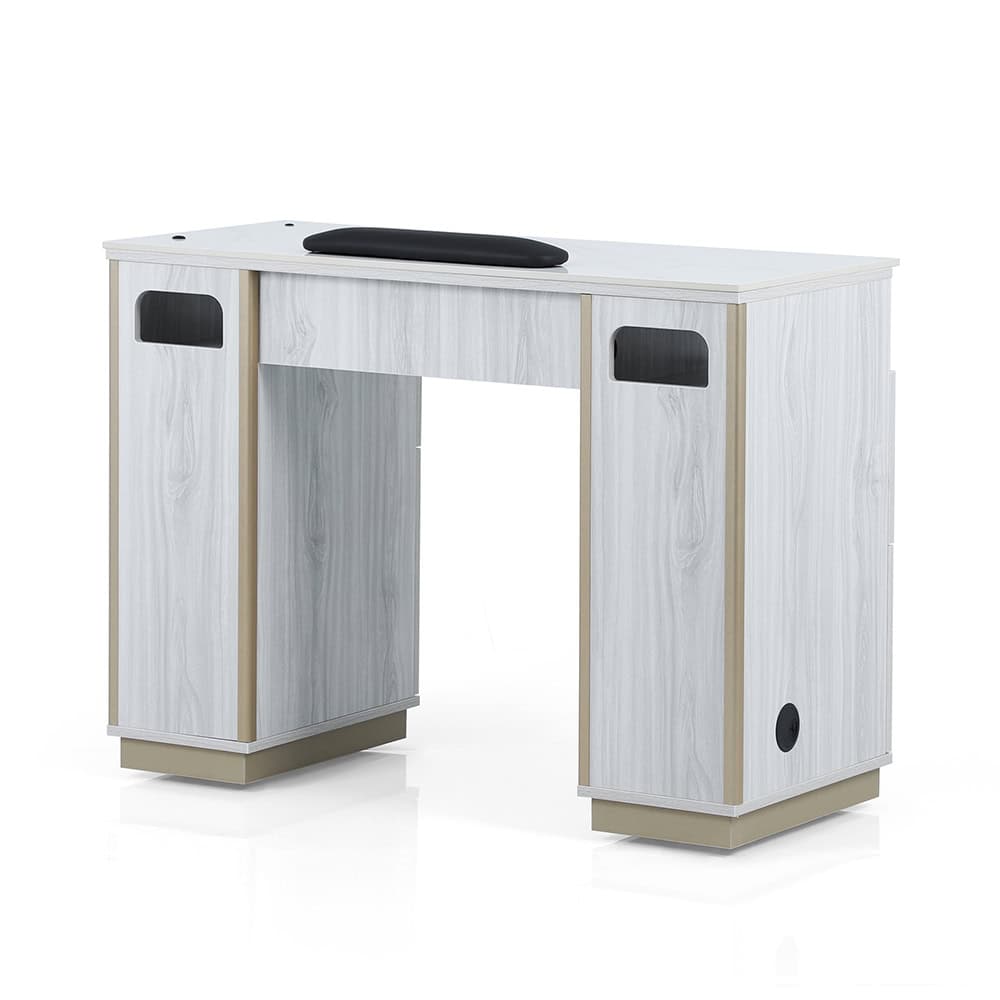
Model N148-2 — Single Manicure Table with Ventilation
• Structure: High-Stability Rigid Station
• Filtration: High-CFM Downdraft Extractor
• Storage: Multi-Drawer Side Organizer
• Application: Dedicated Technician Booths
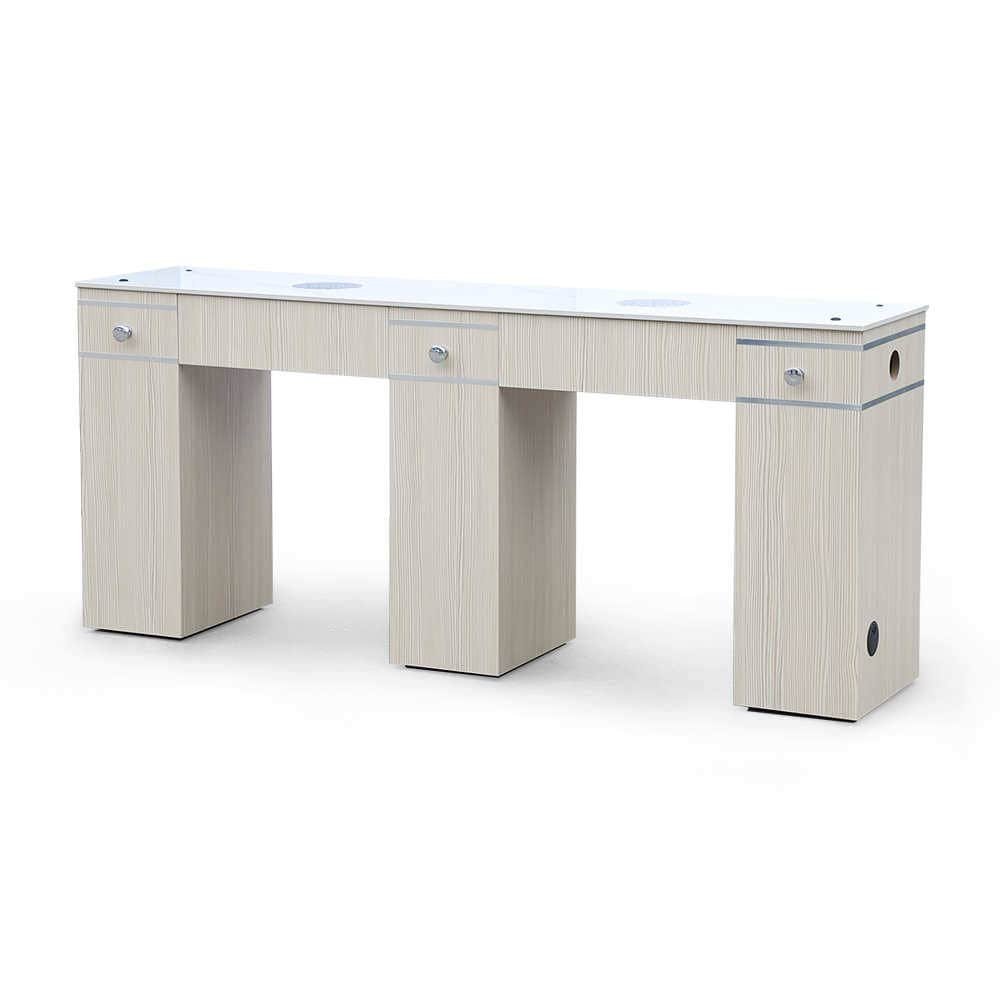
Model N186M — Double Manicure Table with Dual Extractor
• Structure: Dual-Tech Fixed Workstation
• Filtration: Twin Dust Extractors (2x CFM)
• Storage: Central Shared Tower & Cable Ports
• Application: High-Volume Commercial Salons
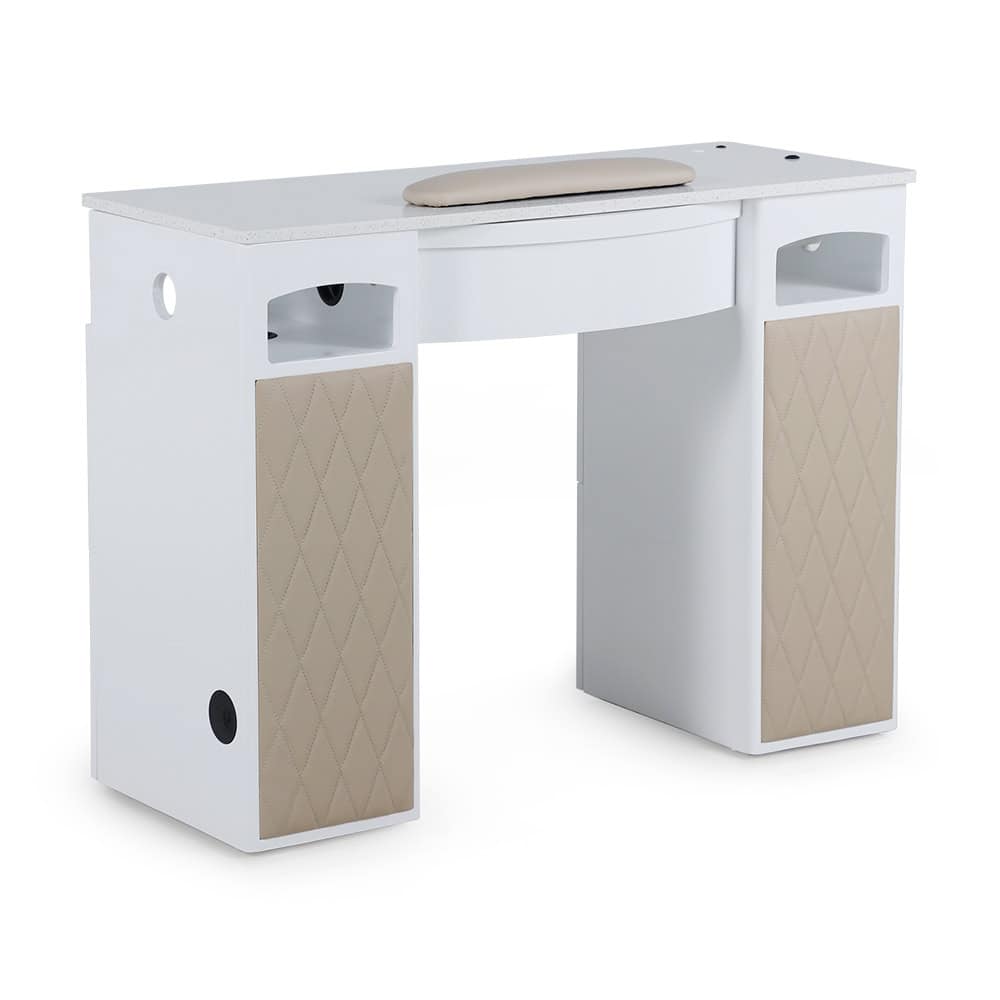
Model N169 — Luxury Marble Top Manicure Desk
• Surface: Acetone-Resistant Marble Countertop
• Filtration: Integrated Silent Downdraft
• Aesthetic: Gold Trim & Fluted Cabinetry
• Application: Luxury MedSpas & Beauty Lounges
Frequently Asked Questions
Yes, provided they are engineered with industrial-grade lockable casters (minimum 50–75 mm diameter) with dual-locking mechanisms (locking both wheel rotation and swivel axis) mounted on a reinforced steel or hardwood sub-frame. Lightweight plastic twin-wheel casters flex under client wrist pressure, causing e-file drill skipping and acrylic application inaccuracy.
All four casters should feature independent braking systems for maximum station stability during high-precision nail art and drill filing. If ordering a 4-wheel mobile table, specify dual-action total lock casters where pressing the brake pedal immobilizes both rolling and directional swivel simultaneously.
Not necessarily. While fixed tables often feature larger multi-drawer side towers or double-station footprints (e.g., 180–200 cm width), single fixed manicure stations are available in compact 90–100 cm widths. The primary difference lies in structural mass, vibration dampening, and permanent floor/wall ducting compatibility rather than external tabletop area alone.
Yes. Modern commercial mobile nail desks incorporate self-contained downdraft vacuum fans (300–450 CFM) with multi-layer reusable HEPA filters or activated carbon cartridges. When moving the table, technicians disconnect a single master power cord. Ensure the mobile table frame provides dedicated internal cable routing so power lines do not drag or snag under moving wheels.
Folding and nesting tables are ideal for mobile nail technicians, trade show demonstrations, or temporary weekend overflow stations. However, for full-time 8-hour daily salon operation, continuous client weight and e-file vibration gradually loosen hinge pins and folding leg brackets. Full-frame fixed or rigid-chassis mobile tables are recommended for standard salon operability.
Mobile tables make floor sanitization significantly easier because staff can unlock the casters, roll the station away, and thoroughly mop nail dust and debris beneath the workspace. Fixed tables require careful sweeping around baseboards and pedestals. For tabletop disinfection, look for solid tempered glass, sintered stone, or high-pressure laminate with acetone-resistant marine coatings.
Provide your available floor space (length × depth), technician-to-client seating clearance (recommended 90–100 cm between tables), required drawer storage side (left/right/both), electrical outlet wall locations, and built-in dust extractor voltage/plug requirements (110V US / 220V EU). KANGMEI engineers custom OEM layouts to fit tight room layouts.
For standard catalog configurations (N186M, N148-2, N169, N078), our wholesale MOQ starts at 2–5 units with a typical manufacturing lead time of 15–20 business days. For full custom OEM salon projects (custom laminate finishes, logo branding, specialized dust extraction ducting), MOQ is 10 units with a 20–25 business day production window.
Final Recommendation
For a genuinely multi-use small salon, choose a mobile manicure table with a rigid frame, reinforced caster mounts, accessible brakes, controlled drawer movement, and a complete cable-storage routine. For a dedicated nail station, choose a fixed table when it provides better storage, permanent cable routing, and a consistent local-exhaust setup.
The most reliable decision comes from a taped floor plan, an operating-footprint test, a ventilation plan, and sample approval. A table should support the salon’s workflow after the chairs, drawers, dust equipment, cords, cleaning process, and client route are all included.
Request a KANGMEI project quotation. Share your room drawing, table quantity, preferred dimensions, mobile or fixed configuration, storage list, ventilation method, electrical requirements, finish, destination, and delivery target. Ask for a dimensioned proposal and sample-validation checklist before confirming production.